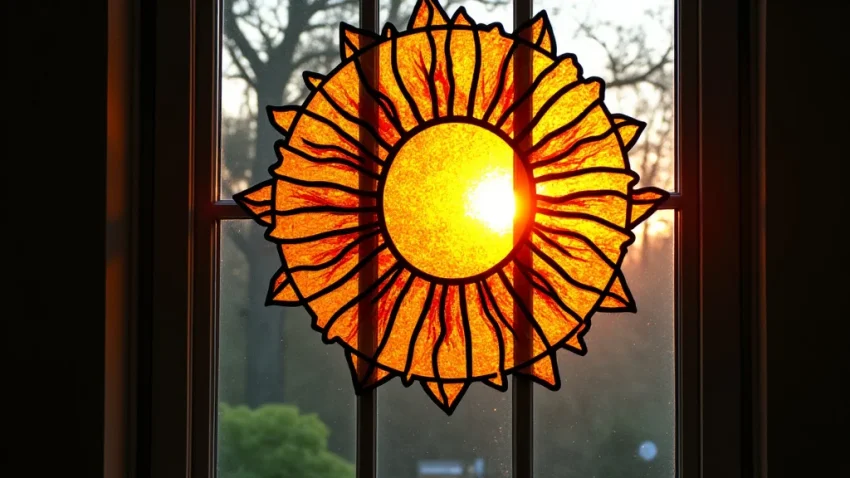
Making your own window sun catcher stained glass can seem tricky, especially for folks just starting out. You might worry about sharp glass or complicated steps. But don’t let that stop you!
It’s a lot simpler than you think, and we’re here to show you exactly how to do it, step by step. Get ready to add some sparkle to your windows!
Key Takeaways
- You will learn the basic supplies needed to start making stained glass sun catchers.
- You will understand the different types of glass suitable for sun catcher projects.
- You will discover how to safely cut and shape glass pieces.
- You will learn the techniques for joining glass pieces together.
- You will find out how to finish and hang your sun catcher.
- You will be able to create your own unique window sun catcher stained glass designs.
What You Need To Make Window Sun Catcher Stained Glass
Getting started with window sun catcher stained glass means having the right tools and materials. This project is very rewarding and can bring a lot of color and light into your home. Think of it as painting with glass.
The light shines through, making beautiful patterns on your walls and floors. It’s a wonderful way to express your creativity.
Essential Tools for Glass Crafting
To begin, you will need a few key tools. A glass cutter is your primary tool for scoring the glass. You’ll also need running pliers to help break the glass along the score line.
Safety is super important, so always have safety glasses to protect your eyes and cut-resistant gloves to protect your hands from sharp edges. A soldering iron and a soldering stand are necessary for joining pieces. You’ll also need flux, which helps the solder flow smoothly, and a flux brush to apply it.
A small brush for cleaning and a ruler for measuring are also helpful.
- Glass Cutter A specialized tool with a sharp wheel that scores the surface of the glass. This score line is where you will break the glass.
- Running Pliers These pliers have a curved jaw that applies even pressure on both sides of the score line, making a clean break.
- Safety Glasses Protecting your eyes is vital. Glass can chip or break unexpectedly, sending small shards flying.
- Cut-Resistant Gloves Gloves made from materials like Kevlar help prevent cuts from sharp glass edges.
- Soldering Iron A tool that heats up to melt solder. It needs to reach a high enough temperature to create a strong bond between the copper foil.
- Soldering Stand A holder for your hot soldering iron, keeping it stable and preventing accidental burns or damage to your workspace.
- Flux A chemical agent that cleans the metal surface and prevents oxidation during soldering, allowing the solder to bond properly.
- Flux Brush A small brush used to apply flux precisely to the areas where solder will be applied.
- Copper Foil Tape This adhesive tape is wrapped around the edges of each glass piece. It provides a surface for the solder to adhere to.
- Solder A metal alloy, typically made of tin and lead, that melts at a relatively low temperature and solidifies into a strong joint.
- Patina (Optional) A chemical solution applied after soldering to change the color of the solder lines, often to black or copper.
- Cleaning Supplies Rags, glass cleaner, and a brush for tidying up your work area and your finished piece.
Choosing Your Glass
The type of glass you choose dramatically affects the final look of your window sun catcher stained glass. For beginners, it’s best to start with easier-to-cut glass like cathedral glass or opalescent glass. Cathedral glass is transparent and has a smooth texture, allowing light to pass through beautifully.
Opalescent glass is opaque; it doesn’t let light pass through as easily but offers vibrant colors and patterns, creating a different kind of glow. Avoid textured or very thick glass when you are first learning, as it can be harder to cut and handle. The variety of colors and textures available is vast, so pick what inspires you!
Consider how the light will interact with your chosen glass. Transparent glasses will allow light to shine through, illuminating the colors and creating colorful patterns on your walls. Opaque glasses will block some light but will still appear vibrant when the sun hits them, offering a more diffused glow.
Some specialty glasses have unique effects, like iridescent finishes that shimmer with different colors or streaky glasses where two or more colors are swirled together. For a first sun catcher, simpler is often better to focus on learning the techniques.
A great starting point is a selection of brightly colored transparent glass. Reds, blues, greens, and yellows are popular choices. You might also want to try a piece with some simple streaks or swirls for visual interest.
Remember that stained glass is sold in sheets, and you can often buy smaller sample packs or individual sheets to start. This allows you to experiment with different colors and types without a large initial investment.
Designing Your Sun Catcher
Your design is where your creativity truly shines. For your first window sun catcher stained glass project, keep it simple. Think about geometric shapes like squares, triangles, or simple curves.
These are easier to cut and fit together. You can sketch out your design on paper. Trace your shapes onto the glass.
Many patterns for sun catchers are available online or in craft books. Don’t be afraid to look at existing designs for inspiration.
When designing, think about how the pieces will fit together. Leave a small gap between pieces for the copper foil and solder. This gap is often called the “grout line” or “solder line.” For a beginner, a design with fewer pieces and straight lines is ideal.
You can gradually move to more complex shapes and curves as you gain confidence. Consider the size of the window where it will hang; larger designs might need more support.
Here is a simple design idea:
- Draw a circle on a piece of paper. This will be the outer edge of your sun catcher.
- Inside the circle, draw a smaller concentric circle.
- Divide the area between the two circles into equal sections, like slices of a pie.
- Draw a star shape in the center, overlapping the inner circle.
- You now have a basic pattern with a central star and radiating sections. You can color these sections with different glass colors.
The Process of Creating Your Stained Glass Masterpiece
Once you have your design and materials ready, it’s time to bring your window sun catcher stained glass to life. This involves cutting the glass, applying the copper foil, and then soldering everything together. Each step is important for a beautiful and durable finished product.
Taking your time and being precise will lead to the best results.
Cutting and Shaping the Glass
This is where the glass cutter comes into play. You need to score the glass, not cut all the way through it. Place the glass on a flat, stable surface.
Hold the glass cutter firmly and apply steady, even pressure as you run it across the glass along your pattern line. You should hear a faint “screeching” sound. This is your score line.
Don’t go back over the same score line; one clean score is all you need.
After scoring, use your running pliers to break the glass. Place the jaws of the pliers on the score line, with the “bump” in the jaw centered on the score. Gently squeeze the handles.
The glass should snap cleanly along the score. If it doesn’t break cleanly, you might need to gently tap the glass from the underside near the score line with the ball end of your glass cutter. Be patient; practice makes perfect.
For curves, you might need to make several small score lines and break them off incrementally.
If your edges are a bit rough, you can use a small grinding tool to smooth them. However, for simple shapes and well-executed breaks, this might not be necessary, especially for your first project. Always wear your safety glasses and gloves during this entire cutting process.
Even small pieces of glass can be sharp.
Applying Copper Foil
With your glass pieces cut, the next step is to apply copper foil tape to the edges of each piece. This tape has an adhesive backing. Peel off a section of the tape and carefully wrap it around the edge of a glass piece.
Try to keep the tape centered on the edge, so an equal amount of the tape wraps over the front and back of the glass. Press the tape down firmly to ensure it sticks well. You can use a plastic or wooden tool to burnish the foil, making sure it adheres tightly to the glass.
This foil is crucial because solder will not stick directly to glass. The copper foil creates a surface that solder can bond to, holding all your pieces together. For curved edges, gently bend the foil as you go.
Overlap the foil slightly where the ends meet and press them down securely. Make sure the foil covers the entire edge without any gaps. If a piece of foil is too long, you can trim it with scissors.
It’s important to be neat with your foiling. The edges of your foil will become the lines of your stained glass piece. Overlapping foil ends should be pressed down flat.
If the foil isn’t sticking well, the glass edge might be dusty; wipe it clean before applying the foil. This step can be a bit time-consuming, but it is essential for a strong and attractive finished product.
Soldering Your Sun Catcher
Now comes the exciting part: soldering! First, place your foiled glass pieces together on a heat-resistant surface, like a corkboard or a ceramic tile. You can use small pins or tape to hold them in place if needed.
Apply flux to all the copper foil edges. Flux is sticky and helps the solder flow evenly. Then, heat your soldering iron and touch it to the solder.
The solder will melt and flow onto the fluxed copper foil. You want to create a smooth, raised bead of solder along each seam.
Start by tacking the pieces together with small dots of solder at key points. Once the main structure is secure, go back and create a continuous solder line along each seam. Aim for a rounded, consistent bead.
Don’t use too much solder; it’s better to add more if needed than to have large blobs. Work in a well-ventilated area because soldering produces fumes. Be careful not to overheat the glass, as this can cause it to crack.
After soldering one side, carefully flip the piece over and solder the other side. Once both sides are soldered, you can apply a patina if you wish. Patina is a chemical solution that changes the color of the solder from silver to black or copper, giving your window sun catcher stained glass a more traditional look.
Clean the piece thoroughly afterward with a mild soap and water to remove any flux residue. Then, dry it completely.
Here’s a typical soldering process:
- Prepare your workspace with heat-resistant material and ventilation.
- Assemble your foiled glass pieces according to your design.
- Apply flux to all exposed copper foil edges.
- Melt a small amount of solder and run it along the seams, creating a bead.
- Continue soldering all seams on one side, ensuring a smooth, consistent line.
- Carefully flip the piece and repeat the soldering process on the other side.
- Clean off any excess flux.
- Apply patina if desired, following product instructions.
- Thoroughly clean and dry the finished sun catcher.
Finishing Touches and Hanging
The final step is adding the hanging mechanism. You can solder small loops or rings onto the top edge of your sun catcher. Make sure they are securely attached to the main solder lines.
Alternatively, you can use specialized hanging rings that clip onto the edge. Ensure the hanging point is strong enough to support the weight of your piece. Before hanging, give your window sun catcher stained glass a final polish with a soft cloth and a bit of glass cleaner.
When choosing where to hang your creation, consider how sunlight will hit it throughout the day. A window that receives direct sunlight will make the colors pop and cast beautiful patterns. You can hang it in a kitchen window, a living room window, or even as a decorative piece on a wall.
For larger or heavier pieces, consider using stronger hooks or a suction cup hanger designed for glass. Enjoy the light show!
Common Myths Debunked
Myth 1: Stained Glass Is Too Difficult for Beginners
Many people believe that stained glass, especially creating a window sun catcher stained glass, requires advanced skills and years of practice. The reality is that with basic tools, clear instructions, and a willingness to learn, beginners can achieve beautiful results. Simple designs are very manageable, and the techniques are straightforward to pick up.
The key is patience and starting with manageable projects.
Myth 2: You Need Expensive Professional Tools to Start
While professional tools can offer greater precision and efficiency, you don’t need to break the bank to start. Basic starter kits for stained glass are widely available and include all the essential tools like a glass cutter, pliers, and a soldering iron. These kits are designed for hobbyists and are perfectly adequate for creating stunning sun catchers.
The cost of entry is much lower than many people assume.
Myth 3: Soldering Stained Glass Is Dangerous Due to Fumes
Soldering does produce fumes, and it’s true that working in a well-ventilated area is important. However, with simple precautions, the risks are minimal. Opening windows or using a small fan to direct fumes away from you is usually sufficient for hobbyist crafting.
Using a fume extractor is an option for those who want extra protection, but it’s not strictly necessary for occasional crafting sessions.
Myth 4: Once Soldered, the Glass Can’t Be Changed
While stained glass is permanent once soldered, minor adjustments are possible. If a piece isn’t fitting quite right, you can often carefully re-melt the solder in that area with your soldering iron to adjust the position of the glass. For significant errors, it’s sometimes possible to de-solder pieces, although this can be more challenging and might require re-foiling.
It’s always best to measure and cut accurately the first time.
Frequently Asked Questions
Question: What is the easiest glass to cut for a sun catcher?
Answer: For beginners, smooth, transparent glass like cathedral glass or smooth opalescent glass is easiest to cut. Avoid heavily textured or very thick glass until you gain more experience.
Question: How do I keep my glass pieces from moving while I solder?
Answer: You can use small pins or clamps to hold the glass pieces in place on your work surface. Sometimes, a bit of low-tack tape can also help secure them temporarily.
Question: Can I use any kind of tape instead of copper foil?
Answer: No, copper foil tape is specifically designed for stained glass. It has the right adhesive and thickness to create a strong bond with solder. Other tapes won’t work for this purpose.
Question: How long does it take to make one sun catcher?
Answer: For a beginner, a small, simple window sun catcher stained glass might take anywhere from 2 to 4 hours, spread over a couple of sessions to allow for cooling and careful work. More complex designs will take longer.
Question: Where can I buy stained glass supplies?
Answer: Stained glass supplies can be purchased from local craft stores that specialize in art supplies, dedicated stained glass supply shops, or through many online retailers.
Wrap Up
Creating your own window sun catcher stained glass is a fun and achievable craft. You’ve learned the essential tools, how to select glass, and the steps for cutting, foiling, and soldering. With a little practice, you can make beautiful, light-filled art for your home.
Start simple, enjoy the process, and let your colorful creations shine!